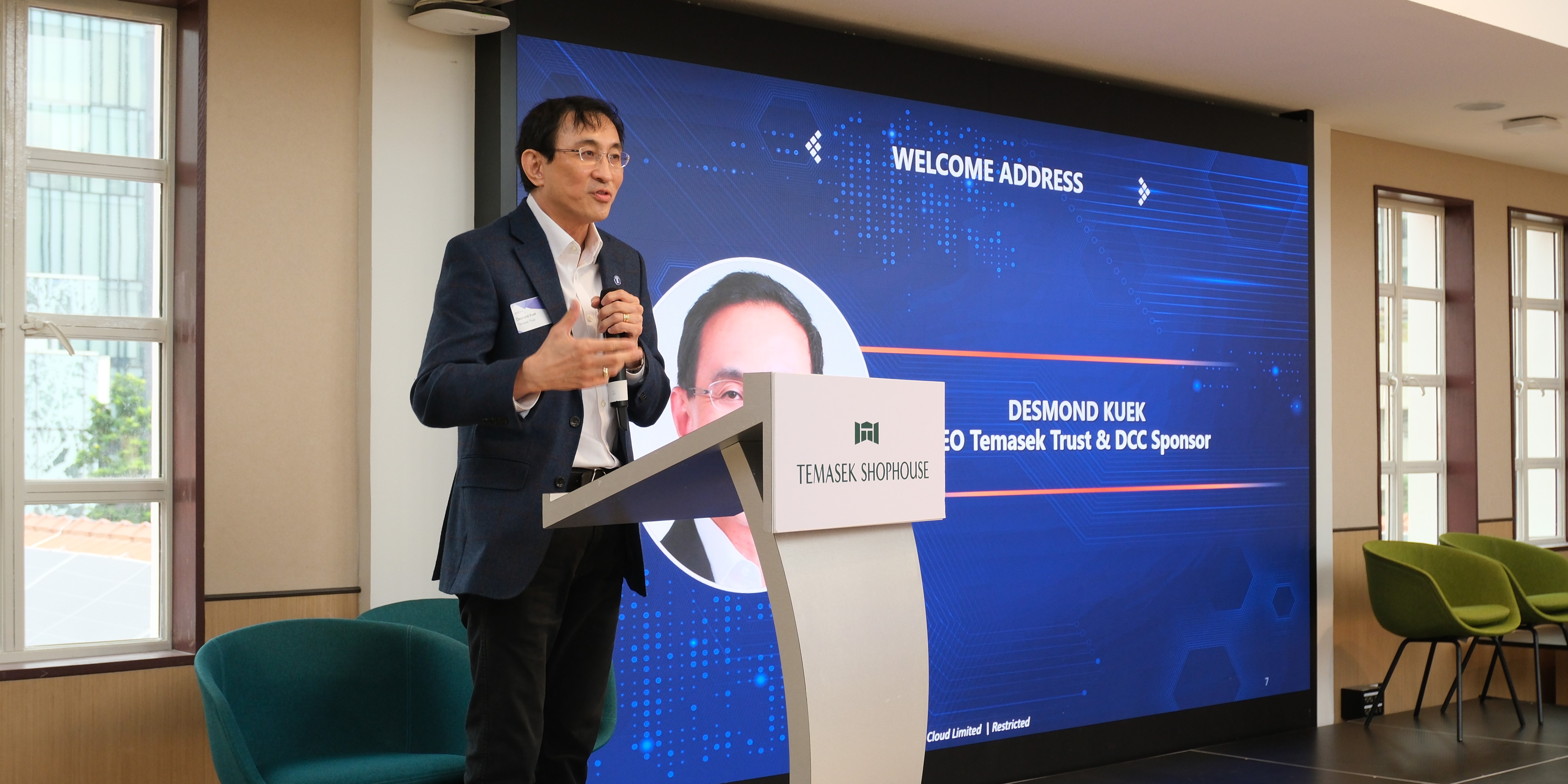


Good morning, and happy new year.
It’s a privilege to welcome all of you here at Temasek Shophouse, under the Tembusu Canopy. We like to think that this space is more than a venue — it is a symbol of community, collaboration, and sustainability.
The story of this place stretches back two centuries. In the 1800s, Dhoby Ghaut was a hive of activity. The Hindi word dhoby means “washer man” and ghaut refers to the steps or landing place along the river bank of, in this case, Sungei Bras Basah. Apart from laundry activity, here was also home to horse stables and carriage companies, in service of colonial Singapore’s transport needs.
In the 1920s, with the introduction of cars as Singapore modernised, the shophouse was developed by Wearne Brothers into the Malayan Motors showroom. If you look around later, you will see a ghost sign on one of the walls showing an old signage with bits of words spelling Wearne Brothers and Baker Cars.
By 1929, this building even hosted Malaya’s first privately purchased aeroplane, the Avro Avian, which was displayed downstairs for the public to see.
So, for many decades, the space here has represented progress and innovation. Today, we have dusted off its history, but kept its heritage, and now as part of Temasek Shophouse, it serves a new purpose — beyond commerce, to community. Not machines for mobility, but a movement for impact.
We call this hall the Tembusu Canopy because it embodies this journey. Where innovation was once displayed in the form of cars and planes, it now takes the form of convening ideas, partnerships, and social change. The tembusu tree is resilient, enduring, deeply rooted, and reminds us that transformation is not just about progress, but about continuity across generations.
It is a fitting place to speak about how digital transformation can help us build a more resilient and compassionate society.
Setting the Context
The pace of change is arguably faster and more profound today than it has ever been these past two centuries — from agricultural to industrial age, and today’s digital age.
There is a cost that we must all be mindful of. The planet we inhabit is being over-consumed, and over-polluted. People face climate and health related challenges. Geo-politics and economics may cause sharper income and social disparities between those who have and can, and those who don’t. Seniors struggle with isolation, and young people navigate pressures that didn’t exist a generation ago.
At the same time, technology is reshaping every aspect of our lives with fresh opportunities — from how we shop and learn, to how we connect and care.
Why Digital Transformation Matters
Our social services sector needs to keep up with this pace of change too. Digital transformation is not about gadgets or apps. It is about rethinking how we deliver care, how we measure impact that matters, and how we collaborate to do more better and faster. The obvious improvements can be described in 3Es:
- Efficiency — because with integrated systems, we will reduce duplication and free up resources for frontline work;
- Effectiveness — because data analytics will help us anticipate needs instead of reacting to when crisis hits us; and
- Equity — because digital platforms will make services accessible to those who might otherwise be excluded —whether due to language, mobility, or in some situations, stigma.
Examples in Singapore
Across the sector, and many of you are deeply involved in championing these changes, we have made substantive efforts to embrace technology. Just to cite a few examples:
- Social Service Net (SSNet): An integrated case management system that allows agencies to share information securely, ensuring families receive holistic support across housing, healthcare, and education.
- AI‑Driven Analytics: Predictive tools can flag seniors living alone or youths disengaged from school, enabling proactive outreach before problems escalate.
- Digital Outreach: Charities are using chatbots and multilingual apps to connect with migrant workers, seniors, and persons with disabilities — breaking barriers of communication and access.
- Virtual Counselling: During the pandemic, tele‑social work ensured continuity of care for mental health and family services, reducing stigma and increasing convenience.
- SkillsFuture Digital Workshops: Vulnerable groups — seniors, low‑income families — are gaining digital literacy, opening doors to employment and lifelong learning.
- Philanthropy Dashboards: Donors can now track the outcomes of their giving in real time, ensuring transparency and accountability while guiding future investments.
Why “Digital Capital Collective” Resonates
This morning, at the start of a new year, it’s as good a time as any to ask — what more can we, must we, do together?
I like the term that you have decided to call this new movement — Digital Capital Collective. It speaks to a powerful idea: that digital is itself a form of capital. Just as financial capital fuels investments, human capital drives innovation, and natural capital sustains our planet, digital capital empowers us with data, connectivity, and intelligence.
It is the infrastructure of modern impact — the networks, platforms, and tools that allow us to scale compassion and precision in equal measure.
A Human Story: People Empowerment through Digital Capital
Imagine a senior living alone in Toa Payoh. She struggles with mobility and rarely leaves her flat. In the past, she might have fallen through the cracks. But today, predictive analytics can flag her as at‑risk. A volunteer, alerted through a digital platform, can visit her in a timelier way. She can receive tele‑health consultations without leaving her home. Her health conditions and vital signs can be monitored remotely by healthcare professionals. She can join an online community group that keeps her connected.
This is not just technology. This is dignity. This is compassion amplified by innovation in digital technology.
A Planet Story: Climate Action through Digital Capital
Let’s imagine another scenario in the climate space. Picture a youth volunteer, passionate about climate action. He joins a mangrove restoration project along the coast. In the past, progress was tracked manually — slow, fragmented, and hard to scale. But today, he can use drones to capture aerial images of the mangroves. Satellite data can feed into a digital dashboard that tracks tree growth, biodiversity, and carbon capture in real time. With this information, scientists, policymakers, and volunteers can collaborate seamlessly. Every tree planted is accounted for, every hectare restored contributes to the national effort toward climate resilience, and every action is transparent to the community.
These digital tools are not just gadgets. They are about empowerment. They allow this and future generations to fight climate change with precision, accountability, and hope. This is digital capital at work for the planet.
The Call to Collaboration
You can think of many, many more applications. The possibilities are limitless, as long as we dare to imagine, endeavour and empower — for efficiency, effectiveness, equity.
But no single organisation can do this alone. We need every one on board in a collective push to a new sector level that is professional, agile, proactive, relevant, and responsive to the needs of every generation. A collective effort where:
- Philanthropists invest boldly and catalytically in innovation.
- Charities adopt new tools and rethink service delivery.
- Changemakers champion inclusion and ensure no one is left behind.
Together, we can build a sector that is future‑ready in serving both people and planet.
Many of you are well placed to lead this multi-pronged effort, wherever you are. We hope you will step forward, in any capacity you can. For all of us, we must lean in to synchronise and support, for the change to be sustained. We hope you will each be forthcoming in sharing your capital and goodwill, across boundaries, in a spirit of collaboration, so that we can bring about better outcomes and positive impact.
Conclusion
Let me conclude by reiterating that digital transformation is not just about efficiency — it is about equity. It is about ensuring that every person here in Singapore, in any generation, has access to the support and the environment they need to thrive.
I would say that the future of our philanthropy and social services is digital. And the future of impact is collaborative. That future is ours to make, here, now, with all of us working together as a collective — a Digital Capital Collective.
END


