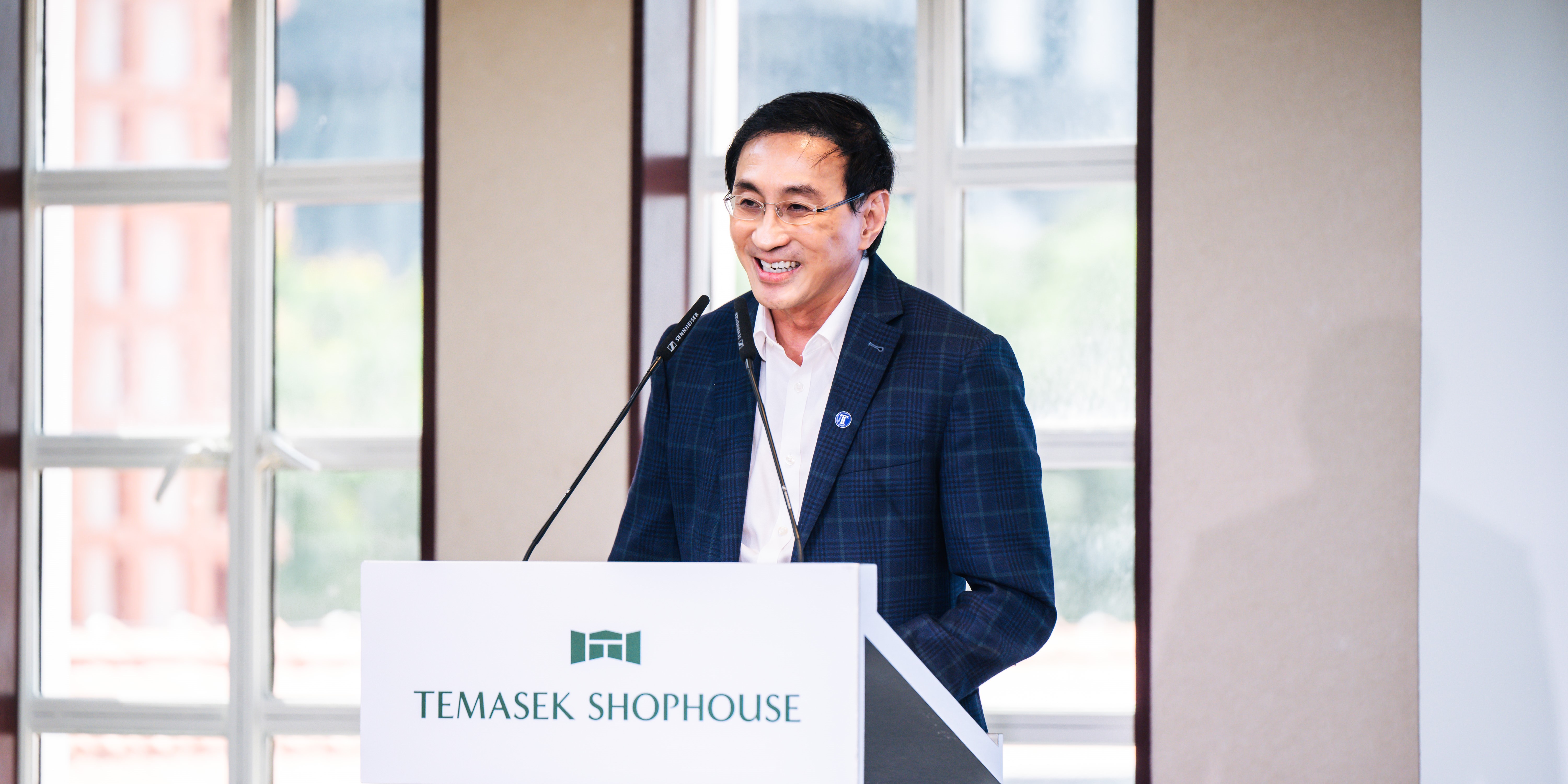


Thank you, Ajay and Ravi, for that most illuminating discussion.
We certainly look forward to how we can mobilise capital across the public, private, and philanthropic sectors through partnerships that are practical, scalable, and enduring.
Because, across Asia, climate risks are no longer abstract. They are immediate, compounding, and deeply interconnected with development challenges and goals in the region.
At the same time in Asia, we see philanthropy evolving very sharply. It is becoming more catalytic, more risk-tolerant, and much more willing to engage where the outcomes are uncertain and stakes are high.
With the scale of climate challenges and development goals we’re setting for all of us in the region, no single pool of capital and no single institution on its own can lift us all up and beyond.
So we are encouraged to be discussing how partnership models with the World Bank Group can be decisive and compelling.
The World Bank brings reach and the ability to operate at national and regional scale. It helps shape policy, mobilise capital, and anchor long-term development pathways.
Philanthropy, by contrast, can move early, move flexibly, and absorb risks that others cannot. It can test new ideas, support first-of-a-kind projects, and build the evidence needed to unlock much larger flows of capital.
As Ajay said earlier, the quieter risk — amidst the challenges of geopolitical volatility and fraying multilateralism — is fragmentation. Good intentions, working in parallel, but not necessarily in concert. Capital deployed, but not always aligned. Effort expended, but not compounded for immediate or more meaningful effect.
So the opportunity before us is not simply to work alongside one another, but to work in concert.
In many ways, we look forward to working with the World Bank and with many of you here today, who have joined us from near and far for the Philanthropy Asia Summit and Ecosperity Week.
To use philanthropic capital to test impactful innovations that the World Bank can then help governments scale.
To complement World Bank financing at the first and last mile, and enable technical assistance to reach those most in need.
To co-create with the World Bank on platforms and mechanisms where governments, communities, and investors can align around practical solutions and mobilise resources for action.
If we get this right, we can shorten the distance between innovation and implementation. We can move from pilots to programmes at scale, and from intent to impact, far more quickly.
Of course, this is not without complexity. We each have different mandates, different expectations, different speeds. But these are precisely the reasons to begin — to test, to learn, and to build trust through doing.
The prize for our partnership in action is not just more capital, but better outcomes. More resilient communities. More investable climate solutions. More development opportunities. More jobs and employment for everyone across Asia.
Let me close the session by thanking all of you for joining us today for lunch with Ajay. It is a pleasure to host you here at Temasek Shophouse, and also for this whole week. On behalf of the Philanthropy Asia Alliance (PAA) team, Shaun, everyone who has been working behind-the-scenes, and especially all of you who have co-organised the partner events with us at the Philanthropy Asia Summit, GenZero Climate Summit, and Ecosperity Week — thank you for an energising and action-filled week.
We look forward to seeing you all at our next Summit in Singapore, and before then, do join us too in Beijing later this year.


