


By Desmond Kuek
Executive Director & CEO, Temasek Trust
January 5, 2026
"You lead, follow, or get out of the way — but you never stand still.”
So begins our next five-year spiral development toward 2030 and beyond, advancing on collective efforts to strengthen our core and shape our future.
Over the past year, in developing our multi-year strategy, we engaged widely with many of you — across generations, throughout our ecosystem, and among our strategic partners. Thank you for all your insights.
Our shared vision should not be regarded merely as a destination, but a compass that provides purpose, direction, and action. More importantly, it represents a continuing journey into the future, empowered by trust and confidence in each of us working together to co-create meaningful outcomes. It is important to understand not only what we aspire to achieve, but why it matters and how we can play our part, individually and collectively. In the impact taxonomy, it is about the intentionality, additionality, and materiality of our collaborative efforts.
VISION 2030 AND BEYOND
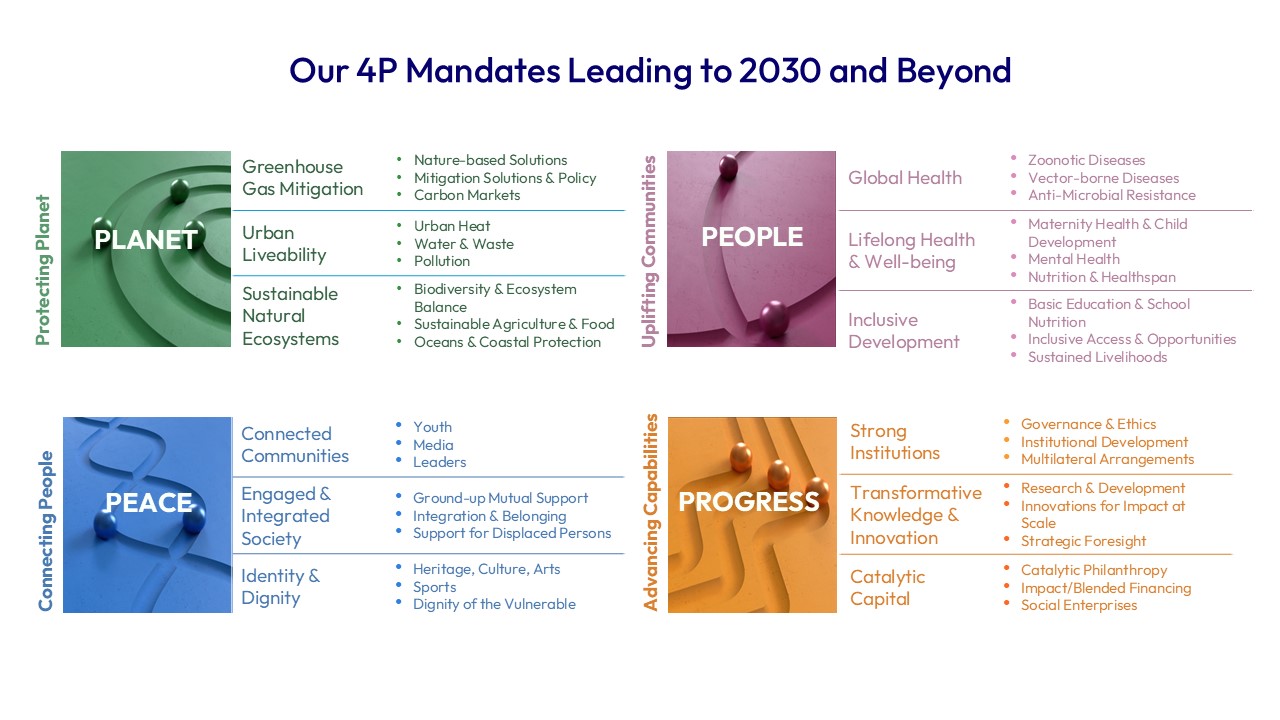
As a trusted steward of philanthropic capital, Temasek Trust upholds sound investment discipline and strong governance, alongside purposeful funding to bring about impact to the community, across our focus domains of Planet, People, Peace, and Progress. We achieve this by being:
- A proactive catalyst for solutions and innovation — guided by systems thinking and evidence-based, data-driven approaches to programming and partnerships for collective impact;
- A thoughtful advocate with strategic outreach and convenorship in the region and beyond — anchoring ourselves as a responsible philanthropic partner in regional, international, and multilateral collaboration;
- An impact investor in nurturing socio-economic enterprises — driving inclusive and resilient growth that delivers both financial sustainability and positive societal value; and
- A capacity builder for people and institutions in the philanthropic sector — developing the talent, professionalism, and future-ready competencies to lead with purpose, integrity, and agility.
At every level, we must create the culture and context that enable lasting change. It calls for HOPE in our collective — with shared values of humility, optimism, partnership, empathy — to redefine stewardship, reimagine philanthropy, and renew trust in the systems that connect us.
Leadership today, and into a future that is faced with geopolitical uncertainty, climate exigencies, and technological disruption — requires a careful balancing of conviction with compassion, innovation with inclusion, agility with accountability, and progress with purpose.
Standing still is not an option. Not to move when the world around us is changing rapidly is to risk being left behind, rendered irrelevant, and made ineffective. Societal expectations, environmental imperatives, and digital possibilities demand new models of leadership and collaboration to build a better future for every generation.
As we chart our course into the new year, we are reminded that positive impact derives not only from what we do, but how we lead.
MINDSET
1 Lead and learn as we go
There is no guarantee we will always get things right, or right the first time — especially when we are blazing new trails and taking considered risks. What is needed is daring initiative, matched with the courage to act, a strong feel for the ground, and the humility to learn.
Across our impact ecosystem, and with all our platforms and beneficiaries, we are establishing a 5-year cycle of planning, risk analysis, system engineering, and impact evaluation — that form a healthy rhythm of progress in a forward spiral of leading and learning, for growth and development.
2 Communicate clearly and authentically
Leadership is only effective with clear, open, and authentic communication. People respond not just to ideas, but to integrity. Connection is both intellectual and emotional, so when we speak about impact goals, programme outcomes, or investment returns, it is not just about performance metrics, but we must also tell the story of why they matter to humanity.
Yet, communication that truly resonates, in engaging minds while touching hearts, is never simple. What is said may not be what is meant, because of fuzzy thinking or careless wording. What is heard may be filtered by personal bias, because people often tune in only to what they want to hear. What is disseminated may be selective, and others along the chain may be left without the big picture.
SYSTEMS
3 Build strong teams that radiate from the core
Change cannot be led alone. Our complex, interconnected, and ever-evolving landscape of challenges obliges a network-centric approach to leadership. Collaboration across our ecosystem is our greatest multiplier.
Strong teams begin, at the core, with leaders who embody a shared set of values and extend their influence outward through expanding circles of trust and alignment. Each node in this network amplifies the mission when connected by purpose, trust, and respect. The systemic change we seek can come about only with synchronous teamwork to address root causes, not just symptoms; and with empowerment flowing from centres of leadership — to the edge in each of our teams.
4 Stay agile and proactive through a systems approach
Agility is not necessarily about reacting faster; it is about sensing and sense-making earlier. By leading with a systems mindset — connecting the dots on people, processes, data, and incentives — we anticipate change rather than chase after it. When we design for the whole instead of optimising silos, we create clarity amid complexity, enabling the organisation and our wider ecosystem to adapt with purpose.
A systems approach instils discipline that enables flexibility. By shortening feedback loops, empowering decision-making with clear guardrails, and continuously improving end-to-end workflows, agility becomes an organic capability and proactivity our default mindset — allowing us to move boldly and decisively when opportunities arise.
5 Focus as much on process as on outcome
Systemic change requires more than vision and intent, it also depends on the often-unseen details of process — governance, workflows, personnel development, and resource allocation. And while quick wins are tempting, lasting progress takes patience and time.
Our vision for 2030 is not an endpoint, but a marker — guiding the way ahead through continuous learning, renewal, and growth. Outcomes give us direction, processes build trust — and we need both to propel forward.
EXECUTION
6 Choose the right time and context for action
Not every good idea is ready for implementation. The art of stewardship lies in discerning when to press forward, when to pause, and when to pivot. Sometimes we go with the flow; at other times we force the pace. There are times when we drop an anchor to hold ourselves against a storm; and other times when we cut loose from past baggage to move more freely forward.
Context matters. Strategies should be framed not as critiques of the past, but as responses to an evolving present. To get the necessary buy-in, each shift in policy, practice, or partnership should be grounded in empathy, sensibility, and impact intentionality.
7 Infuse a sense of urgency and ownership
Starting and staying a course of change requires conviction and commitment. Inertia often hides behind the comfort of familiar practices that appear to be working well enough. But what works today may not be good enough for tomorrow, and we cannot afford to wait until then when it may be too late.
To meet the challenges of our time — from climate resilience to inclusive development — we must act with urgency before crisis compels us. When people understand the why, they are more willing to embrace the how. With this shared impetus, we are more likely to be able to convene like-minded stakeholders — funders, partners, and changemakers — to take ownership of the journey, not as passengers but as co-captains. Transformative impact happens when why now? and why me? give way to why not!
8 Move at a pace that is a bit uncomfortable
If we do not move faster than the gravitational pull of inertia, habit, and structural equilibrium, we risk being pulled back into the old rut. This is a dynamic that is common in organisations navigating change.
While some issues need time to gestate and align, others demand swifter and more decisive action, often addressing challenges across multiple fronts simultaneously. This is especially pertinent with interdependent functions and processes — where gaining that momentum of change is critical. Discomfort is often the price for growth and progress.
CULTURE
9 Drive new behaviour through culture
Culture is a powerful lever for change. Structural or policy shifts will not endure without a corresponding change in mindset. We know that structure drives behaviour, but it is people who ultimately shape structure. We also need a shared language to forge alignment and identity in the organisation. When our words reflect our values, culture takes shape, behaviour follows, and the transformative change we seek becomes more self-sustaining.
What is key is to nurture an open culture that embraces collaboration, feedback, and learning — where doing good, doing well, and doing right are not competing ideals, but complementary imperatives in our continuing endeavour for collective impact.
10 Give credit and take responsibility
Collaborating across boundaries is easier when everyone can see a clear win for all. It is tested most when resources are constrained, or one party must give more than the other for a common good.
This is when enlightened leadership is critical. Trust is forged when leaders have the integrity to take responsibility for setbacks, and the generosity to recognise the contributions of others. In so doing, we also create a safe and conducive space for innovation and experimentation. When coupled with a strong sense of ownership, well-intentioned mistakes are treated as lessons, not failures. The greater risk is inaction born of fear or diffused ownership. When leaders own outcomes — good or bad — they model the kind of accountability that inspires confidence and commitment across our ecosystem.
The mark of leadership is not only how one acts in adversity, but how entrusted power is used to shape what lies ahead. Our future cannot be left to chance or narrow interests. It must be built through collective leadership for impact. So, these reflections are for all of us, at every level. For each of us is a leader and changemaker, and we can make a meaningful difference if we dare to imagine, empower, and act.
As we lead the way forward to our 2030 vision, we continue to empower an ecosystem where trust fuels collaboration, enterprise scales impact, and our people and institutions are resilient and ready for the future.
I wish everyone a meaningful and impactful year ahead!


